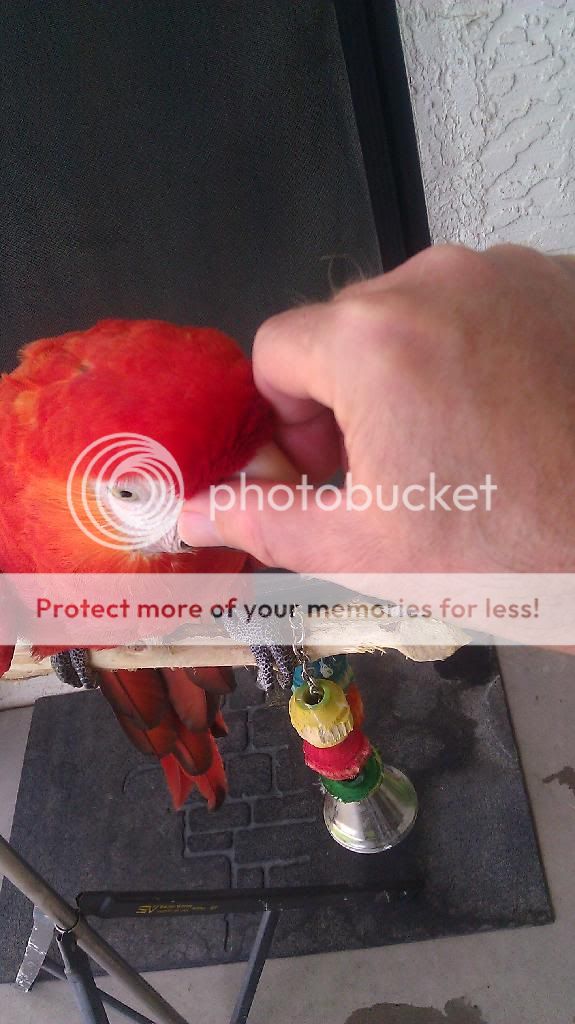
He's making the process harder then it should be! This is how I teach my partner to give nuts to Willie years ago. While Willie is in his cage, put the nut in his food dish daily. I do not give them any treats what so ever. Only my partner gives it to them. Then eventually my partner could hand it to their beak while in their cage. Then eventually while out on the play stand when they see my partner holding the treat, instead of trying to attack, they're focused on the treat and takes the treat without trying to bite. Both macaws will only come to me but they tolerate my partner giving them treats without trying to attack.
I agree... about making it harder than it has to be.
Actually, I taught my seven year old the two fingers on the beak trick, years ago as a seven year old... and she was handling birds as large as Hyacinths.
Two fingers controls that big beak, and prevents the nips, but the person giving the food has to be aware enough to read and react to the bird. Push the beak away, then show the bird the nut. If you want it, take it nice. If he's not nice, push the beak away again. Until he takes it nice...
After about the second try, if he's still acting up, set the nut down, walk away and ignore him for five minutes. Then come back and see if he's had an "attitude adjustment."
Once fed, two fingers on the beak to control him, the other hand slowly reaches out to the side of the face, until the head feathers go sproing, then head scratch. Not for so long that the bird has to put a stop to it, but long enough for him to learn that the person giving the treat is not a threat.
I don't know though. I've always been able to just walk up to even allegedly aggressive macaws, and love on them...
When I taught bird handling classes, a woman came in, at her wits end, with "a biter," and within a minute of meeting him, he had his head on my shoulder talking baby talk getting his head scratched. (And lashed out at the owner for trying to take him back... ) WHY?! I HONESTLY DON'T KNOW...
I always said - only half jokingly - that there is a "macaw gene." And the birds themselves know who has it, and who doesn't. If you have it, they know it, and they behave differently around you. If you don't have it, they know that too, and it doesn't matter what you do, they'll still try and chase you around the room...
I don't know why it is. But it's something they sense in us that seems to set them off. Little subtle cues that we give off, that we're not even aware of... they pick up on it, and respond to it accordingly.
They know who can, and who can't. They know who is afraid, and who isn't.
And they are the most amazingly toddler-like of all the parrots I have ever worked with. I just love them...