Hey guys,
I hope I'm not being annoying by posing this question but currently I'm really trying to change my parrots diet. I've sort of struggled with finding scientific avian nutrition books that are also affordable? I know Bird Tricks has one but quite frankly, without doubting their integrity, it's too expensive for me at the moment. Are there any PDFs or books that detail parrot nutrition in detail with great chop recipes? Currently my parrots would rather eat slabs of concrete than touch any of my chop

I want to know not only which vegetables to use but also WHY I should use them. Thank you in advance!
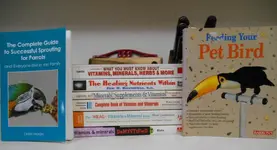
" I want to know not only which vegetables to use but also WHY I should use them. " Based on this statement I would recommend you start with some basic Nutritional Information on Vitamins, Minerals and Amino Acids I think it would help you considerable. I have compiled a few of my favorite books. I laid them out so you could read the spline of the books.
I have quite a collection of avian books some are fantastic and some are so so and some are more geared for the Avian Vet.
Avian Nutrition by Robert G. Black is a pretty good book.
https://www.amazon.com/Avian-Nutrition-Robert-G-Black/dp/0910335044
Comparative Avian Nutrition by K.C. Klasing is another book and you will see a lot of avian authors reference this book in their books.
https://www.amazon.com/Comparative-Nutrition-Publishing-Klasing-1998-01-02/dp/B01K0V4QS0
Avian Medicine 3rd Edition by Jaime Samour MVZ PhD Dip ECAMS
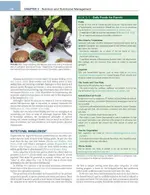
I really love Chapter 3 I will share a few a bit from the chapter I will not share the whole chapter.
https://www.amazon.com/Avian-Medicine-Jaime-Samour-ECAMS/dp/0723438323
While whole foods natural to the species are essential, diets must be informed and complete. Before the middle of the last century, uninformed attempts to provide naturalistic diets to captive exotic and wild birds were the rule. Incomplete diets such as those composed entirely of seed or meat were deficient in calcium and vitamins A and D, and often caused disease and early death.
After essential nutrients were discovered and chemically characterized, formulated “complete” diets became the norm for feeding livestock, including poultry. These products were, and continue to be, composed largely of grain and soy. They are made “complete” with additions of purified micronutrients.
Formulations for pets and exotic and wild captives soon followed, based on the same types of ingredients. The motto in animal science departments became “nutrients, not food.” Although outdated, that approach still prevails in many settings. Indeed, one major manufacturer sells a single formulated diet that is labeled for use in zoo animals ranging from herbivorous hindgut fermenters to carnivores.
Among captive birds, formulations are often used for adult psittaciforms, whose natural diets may consist of fruit, nuts/seeds, invertebrates, flowers, tender leaves, and in some cases nectar. Not surprisingly, formulations are far from optimal for these birds. Soy is poorly digested by birds (Parsons et al., 1981; Elliston and Perlman, 2002; Choct et al., 2010), and grain is a nutrient-poor dietary base for species that did not evolve to eat it (Cordain, 1999; Dewey, 2013). Pelleted diets for parrots have startlingly low bioavailability; only 50% of their protein is absorbed (Kalmar et al., 2007) compared with >85% in naturalistic foods (Sales et al., 2004).
Formulated products also have the major disadvantage of forcing birds to consume a monotonous diet that is inadequate or entirely lacking in most of the essential phytonutrients described above. And because birds’ requirements are highly dynamic, all nutrient levels in formulations are inevitably nonoptimal, over significant periods of birds’ lives, for all species. For certain species, nutrients including calcium and vitamin A are typically present in toxic excess (McDonald, 2003; de Matos, 2008). When birds cannot choose what they eat, they cannot avoid such toxicities, which also arise as a result of too-frequent quality control problems in formulations (Frederick et al., 2003;
http://www.fda.gov/animalVeterinary/safetyhealth/recallswithdrawals/default.htm).
A healthful and complete naturalistic diet for species of any taxon can be knowledgeably created by examining the primary literature (e.g., Witmer, 1996; Gilbert et al., 2003; Brightsmith et al., 2010). Collections of species accounts, notably Birds of the World (Oxford University Press;
http://global.oup.com/academic/content/series/b/ bird-families-of-the-world-bfw/?cc=&lang=en) and Birds of North America (American Ornithologists’ Union;
http://bna.birds.cornell .edu/bna/) are invaluable.
I will include page 28 so you may see the foods chart

I don't feed pellets at all except to Miss Moxie they were the only food she knew for the first few years of her life. We have made great strides in expanding her diet and she doesn't eat many pellets now but as long as she still wants the few that she eats I won't take them away. No other parrot in my care will touch a pellet. Every thing is fresh and prepared daily and it is either put divided in their bowls or hung by skewers. I never worry about favorites because they are every changing.
I do want to say that I respect the choices that people make for their parrots even when it comes to foods they feed.
I don't feed garlic raw but they do get garlic cooked in other dishes. In the book A Guide to a Naturally Healthy Bird: Nutrition, Feeding, and Natural Healing Methods for Parrots by Alicia McWatters she used garlic for fungal infections.
https://www.amazon.com/Guide-Naturally-Healthy-Bird-Nutrition/dp/1884820212
Nutmeg is has psychoactive properties in large doses but I do use it in recipes that they eat. My pumpkin bread recipes calls for 1/2 tsp or 1 tsp for the whole recipe so they would consume a very tiny amount when eaten. Other than in a recipe I would never give it to them.
Another option would be the nutritional bar charts. There are some on Amazon.
https://www.amazon.com/Nutrition-Quick-Study-Health-BarCharts/dp/1423218426