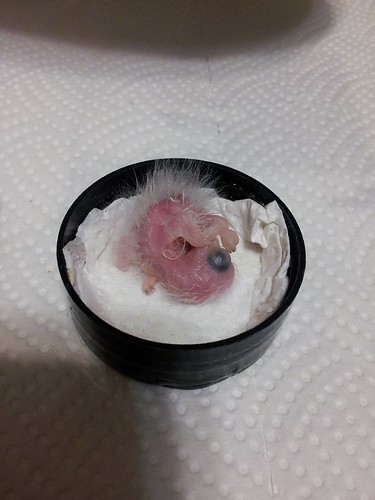
"Bent" hatchling

bostjan

New member
Joined
Apr 28, 2012
Messages
24
Reaction score
0
Location
Vermont
Parrots
Spanky - Congo African Grey
Azu - Turquoise Green Cheek Conure
Sherbert - Pineapple Green Cheek Conure
Bonbon - Cinnamon Green Cheek Conure
Luna - Mealy Amazon
7 Baby GCC's and counting
I apologize if this question was already addressed, but I tried to search and found nothing. Also, this story is probably a sad one, so sorry about that, too.

I've never bred birds before, but this was not exactly done by choice.

Our green cheek conure laid eggs this winter. One of the eggs was smaller than the others, but a chick hatched nonetheless. The hatchling seemed to be rather lethargic compared to the others. She wouldn't lift her head, but she still peeped and we fed her, and she was growing. On day two, she began moving around, but not crawling or waddling...instead she was rolling around, and she still wouldn't lift her head, and she keeps kicking her foot almost nonstop while she's awake.

We live in a rural area without many avian vets nearby, so my wife took a video of the chick and sent it to our vet. She said it looks like the chick is "bent" and probably needs to be put down. We have a great deal of trust for this vet, but I, at first, was skeptical about rushing to put the bird down, because maybe it wasn't so bad in the long run.

I had never heard of this term before, and also need advice. It is almost an hour drive to the nearest vet and it is minus twenty outside. I don't think the little three day old chick would make it through the cold to the vet, and I don't know what to do. She still seems to be eating, but each day the chick seems to be a little more disabled.

I tried searching for "bent" birds/chicks on the internet and saw nothing. The vet said that it typically has something to do with bad incubation or turning. This was an egg that we didn't find right away in the nest, because it was smaller and momma didn't seem to want to incubate it. I had thought that if the chick was badly defected, it wouldn't likely make it, so we would treat it like the others, and it would either get a little better or pass away, but the bird seems to instead be struggling more, but is still taking the formula and still trying to get up.

Thank you so much for any advice you can give.
 
IF that was up to me I'll raise it regardless and keep it for the remainder life that it have with me. For me I don't like to kill/put down if I can help it. I've had bad stuffs happen with baby chicks that were attacked by another male and I was gonna raise him up regardless even though he would be handicapped. Unfortunately he didn't make it as he passed within 5 minutes after I found him while I try to warm him up. Stuffs like that does happen and the parents usually know when there's something wrong with the chick if they choose to ignore it.
 
I too have been thru this before. raising a chick that is either *not normal* or *defective* according to the parents intuition.

They chose not to sit on the eggs knowing there was something wrong with it....you know mother nature --survival of the fittest.

having raised chicks that had stunted growth, trying to raise them from day one, straight thru for 4 weeks, then dyeing was to much for me to take, watching them suffer was heart wrenching,slowly deteriorating day after day, I was wondering if I had done them any service trying to save them.

I just couldn't turn my back on them, but it was a huge learning experience I will never forget.
do what you must, but be prepared if it does not survive. the odds are stacked against it due to it's size, and any hidden health issues,but I commend you for saving it, keeping it warm, and giving it love.
 
12123683823_b6630b5c97.jpg

Here's a picture from yesterday.

At this last feeding, she just held her head up on her own for the first time. It was only for about 2-3 seconds, but I could feel the hope bubbling up inside of me. I know that odds are not in her favour at this point, but I don't know what else to do.

Thank you so much for all of your kind words.
 
just pray for the little guy and I hope he will be alright :)
 
keep it warm on a heating pad(cover it with a towel) on low-medium(around 85 degrees)
nothing fancy-you don't need it, give it a small stuffy to lay against.
 
The picture was taken just before feeding. There is a heating pad under the paper towel in the photo and also a reptile heating lamp just above the station we use to feed the babies. I don't cover them individually, but we have a brooder I made out of two plastic containers nested into each other with water in the lower container and an aquarium heater. An elastic cord holds the top container securely in place so that the water in the outer container comes up as far as possible without risk of spilling. The temperature is regulated to 31-32 deg C (~88-90 deg F), and the humidity is regulated to 50% by a moistened sponge in a separate bowl.

We just had another hatch with his crop empty. Is that normal? The others had a full crop when they hatched.
 
ok good.

now this is something I'm not sure of, an empty crop when born....normally they ingest the yolk before hatching, which is why the parents don't typically feed the first 24 hours....
idk, I'd be interested in seeing other responses....live and learn.
 
I am so happy that you are giving that little baby a chance. If I were in your shoes, I would have to do the same thing. I so hope he survives!
 
IMO dehydration is a major factor and not being addressed. More important than food for the first few days. Of course babies do die and not all are healthy. I too am guilty of raising babies that i shouldn't have.
 
In the picture you've posted, that is a normal picture of the baby. It looks to me that one hatched not super long before you took him out. Are you hand feeding right away or are you leaving with parents to feed??? The other ones shouldn't be hatched out with full crop as they do absorb their egg yolk from their abdominal area. Perhaps when you found them the parents already fed the chicks if you had left them with the parents. The parents will usually start feeding crop milk to the chicks. I think your thinking too much since it's your first batch.
 
I had a chick with paddle leg this year.
Because of that she too was rolling and couldn't lift her head.
I had to bind the legs together,and it is gone thankfully.
Could you show a better picture of the legs?
 
One of our most recent 'tiel clutch looked normal, other than not standing. It would rather sit on its belly, which made feeding a tad tedious. It's come good though and is now indistinguishable in stance from the other five. I have seen and heard of babies being different to the norm, our princess was parent rejected with a deformed beak, and our plumhead was a "runt" and is still smaller than normal at 16 months age. Doesn't stop them living normal (for a companion bird) lives.
 
Now I've never hatched parrots before, but in pigeons, chickens, geese, ducks, etc. And the only time a double yolker survives is when you assist in hatching, otherwise they almost never survive. And in altricial species the chances of them living is even lower (in my experience - they lay less double yolkers and so far haven't had a single double yolker pigeon survive).

That being said, yes, they can develop in double yolkers.
However, a small egg is a problem, as it can stunt the growth of the baby, make hatching difficult (as they can't position quite as well), and a small egg is likely small due to poor genetics & not be sufficient to properly grow a chick.
In some cases, a small egg may be perfectly healthy, chances are not in favor though.
 
Last edited by a moderator:
Wow! Thank you all for all of the support.

The other hatchlings all stood upright pretty much right away. I'm not sure a photo will describe very well what is happening. This second baby has a very difficult time doing anything but doing somersaults. Her head has been facing down except two very short moments during feedings.

My wife assisted the hatch for this baby, but not for the other eggs, so far. The first two eggs were abandoned by the parents. The crops of the first two babies were on the side of the neck. Because this is our first time doing this, and the first two both had similar problems, I didn't think anything of the position of the crop until after the others started hatching.

I don't think this baby is having too much trouble eating, though - she seems to be a little more difficult, but not horribly so.

I'll do some research on paddle leg. That name seems to describe some of what we are seeing.

Mom and Dad bird haven't had anything to do with these eggs since maybe a day or two since they were laid. My wife took the eggs out and put them in the incubator once she realized that Mom wasn't sitting with them. It could be that the eggs went too long without proper incubation or turning, and it might have nothing to do with the size of the egg.

My wife is feeding them right now. They seem to be wanting more food, but their crops appear full. I know that over-feeding can be very dangerous, so I guess we'll just have to feed a little more often. It's been every two hours like clockwork since they started hatching.

The formula is really soupy, I think. I don't know how to get them better hydrated, unless we feed them water...from what I had read, though, we should be giving them enough water in their formula, and there should be enough humidity in their environment most of the time (it is pretty dry in the house, so when they are out for feeding, maybe they are losing too much moisture...I hadn't considered that to be a major issue, since they aren't out very long).

Thanks again for all of your help. I'm really impressed with the knowledge and helpfulness of this forum!
 
Just curious, if you didn't want chicks, why did you incubate them? Even after a day of incubation, there would be nothing but maybe a tiny vein, and air bubble.
 
Well, for one, I think we bought the incubator as a backup, because we were hoping that mom and dad would rear the chicks. And since the eggs were taken out, it seemed to have prompted more eggs. Once Azu started laying, we weren't expecting more than eight eggs, and I really didn't think that more than six would be fertile. She has since been staying with the last two. If either hatch, and she cares for them, then we'll know that she is ready to be a mom. My only concern is if she starts caring for them, and quits, or if she somehow makes us believe that she is, but she isn't, then we might end up without a clue and beating ourselves up for making the wrong choices.

It's easy to tell ourselves that we are doing the best we can, but it is difficult to believe that if something goes wrong.
 
just care for the chick the best you can, and don't be afraid to ask questions....how is it today?
 
I think the "bent" hatchling is doing okay at the moment. She is kicking her foot constantly, always laying on her side when she sleeps, and takes formula okay. This morning she wasn't as active as yesterday afternoon when she straightened out for the first time. Her eyes are getting darker/more pronounced, so maybe they are developing toward opening on schedule...she'll be four days old in a couple hours...I think the eyes usually start to open around one week, but I'm not certain. She seems to be gaining weight, even though I'm not sure how much she's eating, because her crop is twisted. I can see when there is food in the crop, but it's way easier to tell how much with the other chicks.

Her younger brother and sister seem to be doing well, from what I can tell. They are hopping around when they are awake. They seem to have no trouble standing upright, and, at least one of them is gaining weight (the other was just hatched). They do seem to be sleeping a lot, and they aren't making much noise. They peep very quietly when they are out for feeding, and sometimes I hear a couple of peeps just before feeding time. There was a lot of racket for a short time right before the youngest hatched, so I think they were all excited about what was going on.

Thank you very much for asking, and especially for all of your help and support!
 
I would take pictures daily to compare her growth.
it will help you with any changes that you may not notice or remember.

did you give her live bacteria at the very first feeding?
 

Most Reactions

Gus: A Birds Life

Latest posts

Back
Top Bottom