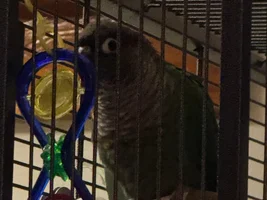
thank you for the answers. This morning I opened the cage, he went outside for a bit, and then I took the balls out. Then I tried to show him the ball in my hand to see if he would come to get it, but he didn't seem very interested. He went back into the cage and continued talking to the metal food bowl because he saw himself in it. I was surprised by this, as I thought he was very attached to the balls. He didn't seem to mind that the balls weren't there. Right now, the balls aren't in the cage, and he's doing the same thing to the metal food bowls. I bought a non-shiny food bowl where he can't see himself; it's arriving today, and I'll remove the metal bowls and put these new ones in. I also bought a natural fiber toy that he can chew on and bite; I'll put that in and see what he does then. When he went outside the cage, he immediately went to the TV and started talking to it. So, in the end, as long as he finds something where he sees himself when he's out in the open, I don't think he'll move away from this anymore. Since we can't remove all the screens from the house, it will continue like this. There's nothing I can do. But this situation is not what I wanted or hoped for.
Hi again. At 19 months old, your bird might be reaching maturity, and going through puberty. It can be a very difficult time, but it is normal for all parrots to go through this phase. There are several things you can do to help reduce hormonal behavior & aggression caused by hormones:
1. Diet is one of the biggest contributing factors to hormonal behavior in parrots. What does your bird’s daily diet look like? A healthy diet should be composed of a combination of fresh vegetables & greens, cooked legumes, & grains, as well as healthy pellets. A lot of people make “chop” for their birds, which is a mixture of chopped veggies, legumes, & grains. I personally feed my birds a diet of roughly 50% chop and 50% pellets. It’s important to keep fats and sugars to a minimum, as they increase hormonal behavior. I personally feed nuts, seeds, & fruits sparingly, as treats ONLY, and directly from my hands.
2. Sleep is very important for your bird. Is he getting 12+ hours of darkness and quiet a night? As seasons change, birds see the shifts in daylight hours as a signal to mate. By keeping a consistent 12+ hours of darkness, it should help reduce hormonal behavior. There are differing opinions on how to do this. Some people use cage covers, as it works best for their situations and space constraints. I personally do not, as some birds can perceive their cage as a nest when it’s covered, which again, can increase hormones. I keep my birds in a separate small room at night where they sleep uninterrupted. I keep it dark with blackout blinds.
3. Reflective or shiny materials and objects should be removed from your bird’s cage. We’ve already talked about this, but reflections can cause your bird to think there is another bird. Understandably, this can cause hormonal and/or aggressive behavior. Unfortunately, there’s no way to remove every reflective surface in your home, so hopefully taking other steps can help improve the situation and reduce the behavior.
I’ll add that having LOTS of toys available that can be destroyed can be helpful. It’s a natural behavior for parrots to shred and destroy. If your bird has something to distract him and occupy his time, it can help with undesirable behaviors. Please also keep in mind that you can never completely get rid of hormonal behavior in parrots. We can only do our best to reduce it. Puberty is particularly difficult, but usually things even out a bit on the other side of it.