Mutation help

Lanazielinski

Member
Joined
Aug 23, 2025
Messages
20
Reaction score
29
Parrots
Indian ringnecks
I'm wondering if anyone can help me identify the colour mutation of my ringneck. I thought cinnamon violet but I'm just not sure. Any ideas?
IMG20250923142530.webp
 
Do you know what his parents were? If he's cinnamon that means that he has two cinnamon genes because it's a sex linked recessive trait. His mother had to be cinnamon and his father had to be cinnamon or carry cinnamon.
If his mother was NOT cinnamon, then your bird is not cinnamon. His ring looks brownish which would indicate that he may be cinnamon.

He also looks to be pallid violet. The pallid gene makes the violet lighter (paler) and its also a sex linked recessive. He must have two pallid genes, one from his mother who had to be pallid for him to be pallid and one from his father who could be pallid or carrying the pallid gene. I don't know if the pallid genes in a ringneck lighten the color of the black ring to brownish cinnamon color making him look cinnamon when he's not.

If he's a pallid violet cinnamon, he's a pretty rare bird. Sex linked recessive males are much less common than females and to have two sex linked recessive genes in a male is quite rare.

Violet isn't dominant or recesdive- it's partially dominant which means that with one violet gene (single factor) the bird will look violet but not as intense a violet in a bird with two violet genes (double factor).

Whatever he is, he's a very pretty bird!
 
I'm not sure of his parents unfortunately. I just wanted to know what his babies would look like. I have him paired to a blue hen so I'll just have to wait and see what they turn out to be. Thanks for the information it's really interesting to learn about how mutations work
 
Assuming his mate is blue.
If he's cinnamon and the female isn't cinnamon, all his daughters will be cinnamon and all his sons will carry the cinnamon gene.
Same with pallid.
If he's violet single factor, half his babies will be violet single factor.

If he has daughters that aren't cinnamon and aren't pallid, you will know that he isn't cinnamon or pallid.
If none of his babies are violet he MAY not be violet. I don't know how many babies a ringneck has in each clutch. The more babies there are without a violet baby appearing the more likely it is that he's not violet.
Isn't genetics fun!
 
I managed to get a better photo of my boy which is hard because he's aviary bred but what do you think about the dilute mutation? It's just bugging me because I can't compare him to any pictures I see online. He's so pale. I'm also in Australia and I heard once that dilute is rare here so any thoughts??
IMG20251110162742.webp
 
I looked at more online images and he looks like violet pallid. Pallid is a sex linked recessive.
 
Ive looked at pallids online and he looks exactly like that but they all seem to have white heads. But I'll find out when he breeds next year I'm sure. Unfortunately his chicks never hatched this year because I think they were "shrink wrapped" and I was devastated for the pair. I don't think they'll try again until next year. I'll keep you updated. Thanks Donnabudgie
 
It's when the inner membrane dries out around the chick and it gets tight and stops the chick from moving and unable to get out of the egg. It's usually low humidity that does it I think. When I opened the eggs the chicks were fully formed but never got out of the eggs unfortunately
 
That's horrible, poor babies! I wonder if that can happen in budgies. I've bred them but never had a problem like that or even heard of it.
 
I enjoy reading about this. I understand the theories. But ZERO practical application. That ringneck is beautiful. Wishing you luck in getting answers to your questions.
 
I barely understand cockatiel genetics, so my head practically imploded reading this thread, LMAO! Genetics is interesting, but math-like research and I do NOT get along.
 
What's hard about this ringneck genetic exercise is that quite a few mutation combinations can result in a beautiful bird like this one.

What i learned and find fascinating is that a lot of small parrot color mutations are shared by and inherited the same way in a lot of smaller species, including budgies, ringnecks, lovebirds, parrotlets, and cockatiels. Traits like opaline, pied, lutino, albino, fallow, cinnamon, clearwing, pallid, dilute, blue, violet, and dark factors are common to all these smaller parrots. What these birds have in common is that they are easy to breed, prolific, and they reach sexual maturity fairly young. This makes them ideal genetic research subjects because you can get grandchildren and great grandchildren of the original birds in less than 10 years. You can't do that with longer lived, less prolific birds thatbreach sexual maturity at 4 or 5 years old like the larger Cockatoos, Amazons, Greys and macaws.
 
It's all fascinating stuff and very complicated. I'm still getting my head around a few of the mutations. I still can't figure out what "ino" is. Ive seen mutations called "aqua ino" and "turquoise ino". Has it got something to do with the lutino mutation?
 
It's all fascinating stuff and very complicated. I'm still getting my head around a few of the mutations. I still can't figure out what "ino" is. Ive seen mutations called "aqua ino" and "turquoise ino". Has it got something to do with the lutino mutation?
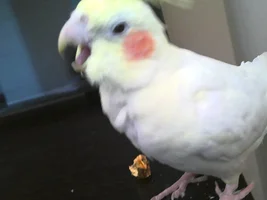
I beleive so. It basically means the color is watered down. Someone correct me if I'm wrong? :D
 
Ino means no black/brown pigment at all. It makes a green bird look yellow (lutino) and a blue bird look white (albino) both have red eyes. Ino is a sex linked recessive. It's carried on the X chromosome. Since male birds have two Xs they need two Ino genes to look Ino. One Ino gene and they don't look Ino but carry the gene. Females only have one X (the other sex chromosome is a Y) so they only need one Ino gene to look Ino.
The beautiful big yellow budgie in the picture is a Lutino. If she didn't have an Ino gene she would be green.

A turquoise Ino is a Turquoise bird with the Ino gene(s). It would be a solid cream colored bird, sometimes called a Creamino. Just like a green Ino bird would be yellow and a blue Ino bird would be white.
20250306_082821.webp
 
Oh ok that's pretty simple. You would not believe how long I've tried to research the answer to that question and come up with nothing. He's a pretty bird is he yours?
 
Yes. Her name is Elan. She's a very large English budgie bred for shows. I know some breeders that breed champion budgies and I buy some of their extra birds that aren't good enough to win shows.
Since Elan is a female, she has one Ino gene on her one X chromosome.
 

Most Reactions

Latest posts

Back
Top Bottom