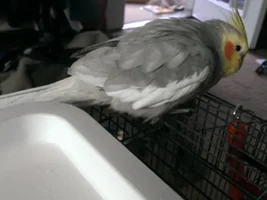
My boyfriend adopted Lucy, the 24 year old electus, about two years ago. She quickly decided she was my bird, and I ended up unexpectedly taking her in. When I adopted her I already had a pair of happy, bonded sun conure boys. I did initial research, checked her with a vet, talked to my local parrot store, and nodded my head. It turns out I wasn't as good at research as I thought I was! I came to this forum today looking for tips to improve Lucy's care and happiness (specifically hormones). And boy, did I find them!
I thought I had done my due diligence. I talked with avian vets for diet needs, I have a dedicated and beloved parrot store nearby that often gives tips and advice. After reading these threads, I am horrified and ashamed. And I sincerely hope my misguided husbandry will not have long term effects on my girl because of my obliviousness. I am writing this post to ask for tips on how to transition her to a healthier diet and lifestyle, especially if anyone has been in the same boat as me!
I'll start off with her current lifestyle, and the reasons I started searching the internet for advice in the first place today:
Lucy doesn't seem to match the typical aloof attitude that most of these threads describe female eclectuses to have. She adores being on my arm or shoulder, and constantly 'mutters' to me to ask for beak rubs and head petting. I try to be careful to not give her more than that. Because if she had her way she would crawl into my mouth and beg me to pet her back like a cat all day. I used to work a demanding 9-5, but the last year has been rough. I injured my back in a horse riding accident so badly I was bedridden for months, and the same day I injured my back, following the CAT scan at the ER, tumors were found in my body, which needed treatment and surgery. I am happy to report that I am healing well after the long-awaited surgery three weeks ago, with good prognosis, but Lucy and I have especially bonded over the last year. She has been an excellent 'therapy bird' as my doctors say. She took to laying on my chest while I was bedridden, and nuzzling into my neck and shoulder. She has been a loving and constant companion. I now work fully remote. And Lucy has taken advantage of this new lifestyle. While recovering from my surgery the past few weeks she got used to me always being in sight of her cage, and the last few days she has began to constantly scream when I am out of the room. A behavior which I am gritting my teeth through as I work with her on stopping it.
And the hormonal issues baffle me. I came here for advice primarily on the hormones. Last year, after I ended up bedridden for a while, she became hormonal for the first time. It was a strong learning curve, and I thought I learned all I needed to to curb it. Consistent dark/light schedules, don't let her trick you into petting her back when you aren't paying attention. This year, I can't break it. And this forum has given me valuable insight into why: pellets and fruit.
It also doesn't help that she is determined to build nests. It's a daily battle of her finding new corners and spaces under the furniture to try to make a nest and me gently talking her out of it and finding solutions to keep each corner and piece of furniture undesirable for nesting.
Her diet has been primarily Zupreem Natural, with a daily preparation of 50% fruits and 50% veggies prepped for free choice with her pellets. I am honestly not sure what balance of fruit and veggies and pellets she ends up eating. Most days she seems to vary in how empty the bowls are. Twice a month I feed her a Sunny-side up egg and it's shell. I source the eggs directly from my parents' little hobby organic chicken operation, if that matters. When I first adopted her 2 years ago, I noticed some wing flipping and toe tapping. Perhaps once a year I will notice the toe tapping start again, but I quickly address it by adding more kiwi into her rotation (an initial Google search showed that kiwi is high in the vitamin she seemed to be lacking to cause the toe tapping. I don't know if that is right, after reading these threads. But it works for her!). Every time adjusting kiwi has fixed it by the next day. I rotate through a variety of fruits and veggies but staples are cucumber (during molting season), apple, blueberry, bell peppers, brocolli, carrot, and kiwi. All of these are universally loved amongst my three parrots, although my fridge stays well stocked with variety. I thought I was doing a good job ensuring she got all of the vitamins and minerals she needed. I am horrified about what I have learned from threads about pellets! But since I have not noticed toe tapping while she has access to pellets I wonder if it is okay if she has a limited amount? I am concerned about transitioning her too quickly to the reccomended diets here, as I don't want her to stubbornly starve herself in hopes of pellets. But, I am determined to follow advice so that she is as healthy as possible.
Another question I have for her husbandry is this: She loves to be pet, as I said. She asks for it constantly. And sometimes she gets feather thinning at the top of her head. Someone mentioned in the threads that eclectuses aren't designed to preen each other, and that the oils in a human's hands can damage their feathers. I very much enjoy preening her, and she often seems happy to let me. Is my petting causing the feather thinning? Is head petting and beak rubbing contributing to the hormone issues?
Thanks for any advice you can give as I continue combing through these threads!
I thought I had done my due diligence. I talked with avian vets for diet needs, I have a dedicated and beloved parrot store nearby that often gives tips and advice. After reading these threads, I am horrified and ashamed. And I sincerely hope my misguided husbandry will not have long term effects on my girl because of my obliviousness. I am writing this post to ask for tips on how to transition her to a healthier diet and lifestyle, especially if anyone has been in the same boat as me!
I'll start off with her current lifestyle, and the reasons I started searching the internet for advice in the first place today:
Lucy doesn't seem to match the typical aloof attitude that most of these threads describe female eclectuses to have. She adores being on my arm or shoulder, and constantly 'mutters' to me to ask for beak rubs and head petting. I try to be careful to not give her more than that. Because if she had her way she would crawl into my mouth and beg me to pet her back like a cat all day. I used to work a demanding 9-5, but the last year has been rough. I injured my back in a horse riding accident so badly I was bedridden for months, and the same day I injured my back, following the CAT scan at the ER, tumors were found in my body, which needed treatment and surgery. I am happy to report that I am healing well after the long-awaited surgery three weeks ago, with good prognosis, but Lucy and I have especially bonded over the last year. She has been an excellent 'therapy bird' as my doctors say. She took to laying on my chest while I was bedridden, and nuzzling into my neck and shoulder. She has been a loving and constant companion. I now work fully remote. And Lucy has taken advantage of this new lifestyle. While recovering from my surgery the past few weeks she got used to me always being in sight of her cage, and the last few days she has began to constantly scream when I am out of the room. A behavior which I am gritting my teeth through as I work with her on stopping it.
And the hormonal issues baffle me. I came here for advice primarily on the hormones. Last year, after I ended up bedridden for a while, she became hormonal for the first time. It was a strong learning curve, and I thought I learned all I needed to to curb it. Consistent dark/light schedules, don't let her trick you into petting her back when you aren't paying attention. This year, I can't break it. And this forum has given me valuable insight into why: pellets and fruit.
It also doesn't help that she is determined to build nests. It's a daily battle of her finding new corners and spaces under the furniture to try to make a nest and me gently talking her out of it and finding solutions to keep each corner and piece of furniture undesirable for nesting.
Her diet has been primarily Zupreem Natural, with a daily preparation of 50% fruits and 50% veggies prepped for free choice with her pellets. I am honestly not sure what balance of fruit and veggies and pellets she ends up eating. Most days she seems to vary in how empty the bowls are. Twice a month I feed her a Sunny-side up egg and it's shell. I source the eggs directly from my parents' little hobby organic chicken operation, if that matters. When I first adopted her 2 years ago, I noticed some wing flipping and toe tapping. Perhaps once a year I will notice the toe tapping start again, but I quickly address it by adding more kiwi into her rotation (an initial Google search showed that kiwi is high in the vitamin she seemed to be lacking to cause the toe tapping. I don't know if that is right, after reading these threads. But it works for her!). Every time adjusting kiwi has fixed it by the next day. I rotate through a variety of fruits and veggies but staples are cucumber (during molting season), apple, blueberry, bell peppers, brocolli, carrot, and kiwi. All of these are universally loved amongst my three parrots, although my fridge stays well stocked with variety. I thought I was doing a good job ensuring she got all of the vitamins and minerals she needed. I am horrified about what I have learned from threads about pellets! But since I have not noticed toe tapping while she has access to pellets I wonder if it is okay if she has a limited amount? I am concerned about transitioning her too quickly to the reccomended diets here, as I don't want her to stubbornly starve herself in hopes of pellets. But, I am determined to follow advice so that she is as healthy as possible.
Another question I have for her husbandry is this: She loves to be pet, as I said. She asks for it constantly. And sometimes she gets feather thinning at the top of her head. Someone mentioned in the threads that eclectuses aren't designed to preen each other, and that the oils in a human's hands can damage their feathers. I very much enjoy preening her, and she often seems happy to let me. Is my petting causing the feather thinning? Is head petting and beak rubbing contributing to the hormone issues?
Thanks for any advice you can give as I continue combing through these threads!