Hglunn02
New member
- Mar 30, 2026
- 5
- 2
- Parrots
- Black Headed Caique
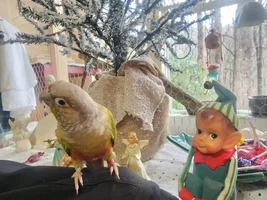
Hello everyone, this is my first post on the forum since getting my(23yo) first bird(16yo), this might bw a bit lengthy. Things are going absolutely amazing with him and he loves just hanging out with me and watching what i am doing. He also will rub his head and neck back on forth like a cat on my neck to dry off/preen himself after his sink shower which is very cute. He has also graduated to hanging out on my shoulder this week since hes being good and i can let him hang out with me as im going around the house.
My problem, which i have encountered this evening, is harness training(Aviator Harness). Before the harness arrived he has been really good at sticking his head through my hand ( ). However, the first time I was able to get the harness over his head he started getting frustrated, and when I take it off his feathers on his neck go the wrong way and he gets even more frustrated. He is fine having it go over his eyes and down his neck, but only once it's fully on and he feels the weight of it, or he accidentally steps on it and pulls his head down a little bit he gets frustrated.
Once i get it off, i take it a step back and just feed him a treat through the harness without it going over his head, then i give him a break, then i switch to another trick for a bit, so he doesn't get traumatized by the harness or wreck our relationship. I don't know what to do because he starts to panic once I get to the point that he can get tangled if im not careful, and he has to cooperate with me to get it off.
How should i react in the moment when he panics? He is really good at the step prior I dont want to make him do anything he hates but its the next step. I noticed in another forum post that i can work with a hairtie instead of my hand, which will allow him to get used to his head feathers going back and forth a little bit, plus he doesnt panic by stepping on it or feeling the weight of it.
He unfortunately is a solo bird, and loves his flying exercises, staring out the windows with me, etc. so I know he is going to love the outdoors but he doesn't know that's what the end goal is. I will take the training incredibly slow at this point but any tips would be nice. He already knows to fly to my hand, spin both ways, and somersault around my finger, and is eager to learn.

My problem, which i have encountered this evening, is harness training(Aviator Harness). Before the harness arrived he has been really good at sticking his head through my hand (
). However, the first time I was able to get the harness over his head he started getting frustrated, and when I take it off his feathers on his neck go the wrong way and he gets even more frustrated. He is fine having it go over his eyes and down his neck, but only once it's fully on and he feels the weight of it, or he accidentally steps on it and pulls his head down a little bit he gets frustrated.Once i get it off, i take it a step back and just feed him a treat through the harness without it going over his head, then i give him a break, then i switch to another trick for a bit, so he doesn't get traumatized by the harness or wreck our relationship. I don't know what to do because he starts to panic once I get to the point that he can get tangled if im not careful, and he has to cooperate with me to get it off.
How should i react in the moment when he panics? He is really good at the step prior I dont want to make him do anything he hates but its the next step. I noticed in another forum post that i can work with a hairtie instead of my hand, which will allow him to get used to his head feathers going back and forth a little bit, plus he doesnt panic by stepping on it or feeling the weight of it.
He unfortunately is a solo bird, and loves his flying exercises, staring out the windows with me, etc. so I know he is going to love the outdoors but he doesn't know that's what the end goal is. I will take the training incredibly slow at this point but any tips would be nice. He already knows to fly to my hand, spin both ways, and somersault around my finger, and is eager to learn.