Very Confused on how to feed an Eclectus

LloydEkkie

New member
Joined
Jun 8, 2026
Messages
9
Reaction score
15
Parrots
Eclectus, cockatiel
Okay so a bit of background info of what I already know. So I have an almost 4 month old male eclectus who is close to weaning. He’s been getting formula, veggies, fruit and pellets. I’m trying to make sure I’m feeding him right thing but whenever I look up the correct diet I get different info every time. I really need like a clear explanation of what they should be fed.

So I know that they are supposed to be fed more veggies than fruit but I saw someone say that they shouldn’t receive fruit at all. I also don’t know if I am supposed to give him different types of veggies everyday. As well as hearing that eclectus parrots shouldn’t eat any pellets either. He currently gets some roudybush not colored pellets and he prefers them over his fresh veggies and fruit so that worries me. When ever I give him fruits and veggies he won’t eat them till a while later unless I feed him them with my hands , however he eats his pellets completely on his own.

Should I give him like only vegetable chop and fruit and pellets a few times a week? Is roudybush pellets good for eclectus parrots( I heard they’re not but I see ppl feed them to Ekkies and they have an ekkie on the cover)?

It would be extremely helpful if someone could write like weekly/daily feeding schedule.
Thanks :)
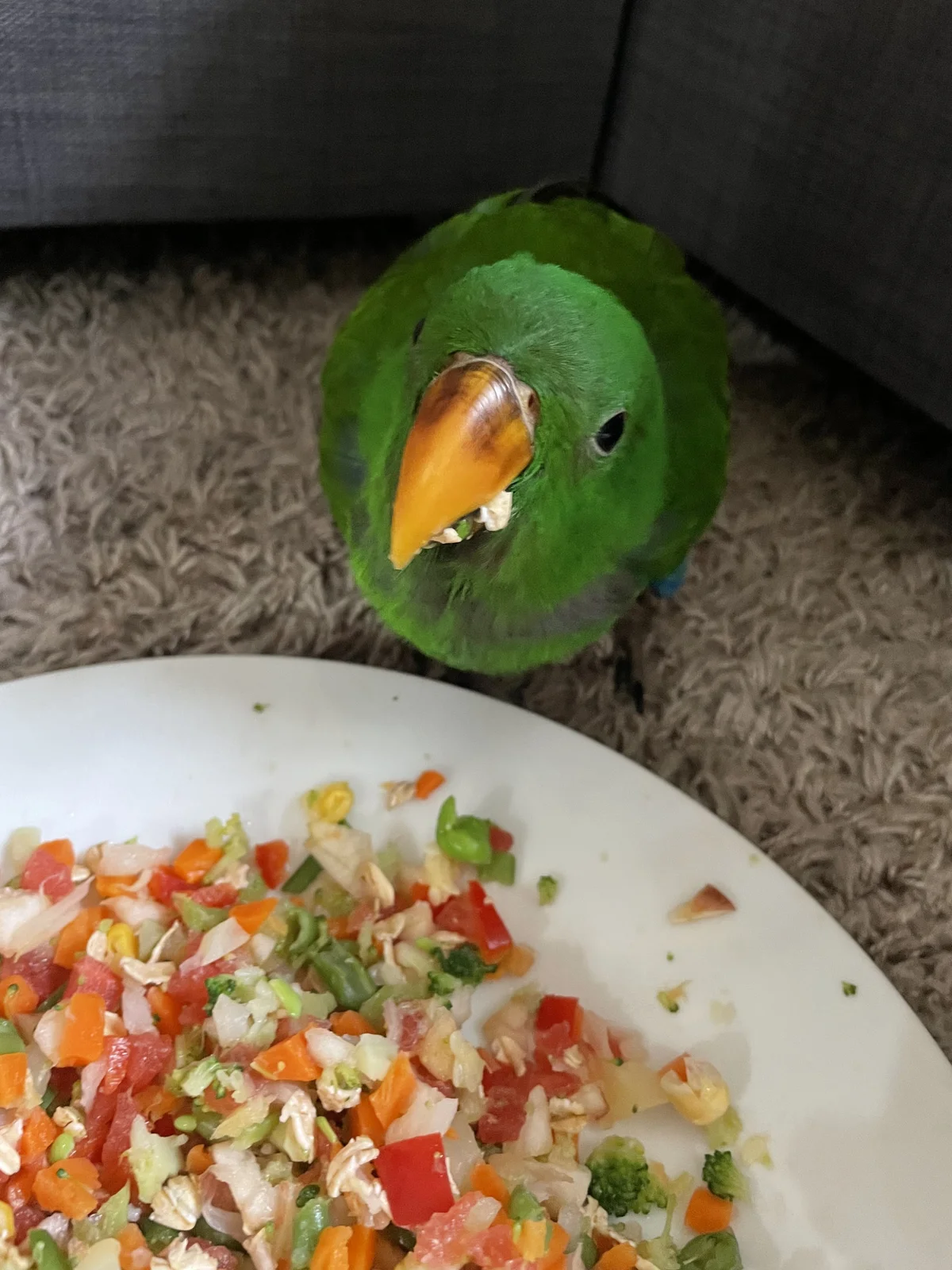
Anyway here’s him eating some chop
IMG_1758.webp
 
You're running into one of the biggest sources of confusion in parrot care. Eclectus parrots are unusual compared to many other companion parrots, and there are a lot of strong opinions online. The good news is that there are a few points that are well-supported, while others are more controversial.

Why Eclectus diets are so confusing​

Eclectus parrots have a longer digestive tract than many other parrots and appear to process food differently. In captivity, some individuals seem more sensitive to highly fortified foods (especially foods with added synthetic vitamins and artificial colors), while others do perfectly well on them. Unfortunately, there haven't been many controlled scientific studies comparing different captive diets, so much of the advice comes from experienced breeders, avian veterinarians, and long-term keepers rather than definitive research.

At almost 4 months old​

The biggest priority right now is weaning correctly, not transitioning to an "adult" diet too quickly.

Your baby should have access to:

  • Formula until he decides he doesn't need it anymore (don't rush weaning).
  • Fresh vegetables every day.
  • Some fruit every day.
  • Pellets available.
  • Fresh water.
If he's still asking for formula, continue offering it. Eclectus babies often finish weaning around 4–6 months, and some take even longer.


Vegetables: this should be the largest part of the diet​

Yes, vegetables should make up the majority of what he eats once weaned.

Aim for lots of variety over the course of a week.

Great vegetables include:

  • Dark leafy greens (kale, collards, dandelion, mustard greens)
  • Bok choy
  • Broccoli
  • Bell peppers
  • Carrots
  • Sweet potato
  • Squash
  • Pumpkin
  • Green beans
  • Peas
  • Corn (more of a treat because it's starchier)
  • Zucchini
  • Cauliflower
You do not have to serve completely different vegetables every single day.

Think of it like this:

  • Have 10–15 vegetables that you rotate.
  • Make large batches of chop.
  • Freeze portions.
  • Add a couple fresh ingredients occasionally.
That's perfectly fine.


What about fruit?​

This is where opinions differ the most.

Some people recommend:

  • no fruit
Others recommend:

  • 10–20% fruit
Others recommend:

  • fruit daily.
In the wild, Eclectus parrots eat a lot of fruit, blossoms, leaf buds, seeds, and vegetation depending on what's seasonally available. The issue isn't fruit itself—it's that pet fruit is often much sweeter than many wild fruits, and a captive bird doesn't burn nearly as many calories.

A reasonable approach is:

  • Mostly vegetables.
  • Some fruit daily or several times per week.
  • Focus on lower-sugar fruits more often.
Examples:

  • Papaya
  • Pomegranate
  • Berries
  • Kiwi
  • Mango
  • Melon
Higher sugar fruits (still okay in moderation):

  • Grapes
  • Bananas
  • Apples
  • Pears
I wouldn't eliminate fruit completely unless an avian veterinarian has a specific medical reason.


Pellets​

This is the most controversial topic.

The "no pellets" group says:​

Eclectus can develop:

  • toe tapping
  • wing flipping
  • hyperactivity
from diets high in synthetic vitamins (especially vitamin A, D, or fortified nutrients).

The "pellets are fine" group says:​

High-quality pellets provide balanced nutrition and are safer than relying on an owner to perfectly balance fresh foods.

Both viewpoints have experienced keepers behind them.


What about Roudybush?​

Roudybush is generally considered a good-quality pellet compared with many brands. It doesn't contain artificial colors, which is a positive.

However, many experienced Eclectus keepers prefer pellets to be only a small portion of the diet, rather than the main food.

The concern isn't that Roudybush is "bad"—it's that your bird already prefers pellets over fresh foods.

That is something I'd work on while he's young because food preferences become much harder to change later.


Should pellets only be a few times a week?​

Personally, I wouldn't remove them abruptly while he's still weaning.

Instead I'd gradually shift things toward something like:

  • 60–70% vegetables
  • 10–20% fruit
  • 10–20% pellets (or whatever amount your avian veterinarian recommends)
  • Occasional cooked grains and legumes (such as cooked quinoa, brown rice, lentils, or sprouted legumes) for variety.
Some experienced Eclectus owners eventually feed little or no pellets, while others maintain a modest pellet portion long-term. Either approach can work if the rest of the diet is carefully managed and the bird remains healthy.


He's only eating veggies if you hand-feed them​

This is actually pretty normal for a baby.

At 4 months, he's still learning:

  • what food is
  • how to eat independently
  • what tastes good
Some ideas:

  • Eat vegetables in front of him.
  • Pretend they're delicious.
  • Hand him pieces.
  • Offer vegetables first thing in the morning when he's hungriest.
  • Mix finely chopped vegetables with foods he already likes.
  • Keep offering the same foods repeatedly—parrots often need many exposures before accepting something.
Don't assume he dislikes a vegetable after one or two attempts.


If he fills up on pellets...​

I would avoid leaving a bowl of pellets available all day if he's ignoring fresh food because of them.

Instead, you could try:

  1. Offer fresh chop first in the morning.
  2. Let him have time to explore and eat it.
  3. Offer pellets later in the day.
That encourages him to sample the fresh foods while still making sure he's getting enough nutrition during weaning.


A balanced approach​

Based on what you've described, I'd aim for:

  • Continue formula until he self-weans.
  • Offer fresh vegetable chop every day, rotating ingredients over the week rather than changing everything daily.
  • Include a moderate amount of fruit rather than eliminating it completely.
  • Keep offering the Roudybush pellets, but encourage fresh foods so pellets don't become his primary diet.
  • Monitor his weight during weaning to make sure he's maintaining it appropriately, and have regular checkups with an avian veterinarian.
One question that would help tailor the advice: How many formula feedings is he still taking each day, and approximately how much does he weigh (in grams)? That can help determine where he is in the weaning process and how aggressively you should encourage independent eating.
 
Congratulations on your beautiful boy! So Piccolo has access to pellets 24/7. He eats a mixture of Roudybush and Harrison's. He eats a variety of vegetables and fruits daily too. In the morning I actually make him a mash from a place called Avian Organics, shipped in from Canada. He gets a variety of grains, etc. with those. Nuts are used for training or treat, but sparingly. The big thing is that you don't want the little guy to be hungry, but also not overfeed either. Some of his favorites are spinach, carrots, banana chips with zero sugar or sweetening, peaches, papaya, sweet potato, green beans, peas, pineapple, blueberries. Apple is his absolute favorite though. Specifically Cosmic and Sugarbee apples. Feed the rainbow is what we were told with him. Others may have better advice, but that is what we are doing.
 
  • Like
Reactions: AMD
You're running into one of the biggest sources of confusion in parrot care. Eclectus parrots are unusual compared to many other companion parrots, and there are a lot of strong opinions online. The good news is that there are a few points that are well-supported, while others are more controversial.

Why Eclectus diets are so confusing​

Eclectus parrots have a longer digestive tract than many other parrots and appear to process food differently. In captivity, some individuals seem more sensitive to highly fortified foods (especially foods with added synthetic vitamins and artificial colors), while others do perfectly well on them. Unfortunately, there haven't been many controlled scientific studies comparing different captive diets, so much of the advice comes from experienced breeders, avian veterinarians, and long-term keepers rather than definitive research.

At almost 4 months old​

The biggest priority right now is weaning correctly, not transitioning to an "adult" diet too quickly.

Your baby should have access to:

  • Formula until he decides he doesn't need it anymore (don't rush weaning).
  • Fresh vegetables every day.
  • Some fruit every day.
  • Pellets available.
  • Fresh water.
If he's still asking for formula, continue offering it. Eclectus babies often finish weaning around 4–6 months, and some take even longer.


Vegetables: this should be the largest part of the diet​

Yes, vegetables should make up the majority of what he eats once weaned.

Aim for lots of variety over the course of a week.

Great vegetables include:

  • Dark leafy greens (kale, collards, dandelion, mustard greens)
  • Bok choy
  • Broccoli
  • Bell peppers
  • Carrots
  • Sweet potato
  • Squash
  • Pumpkin
  • Green beans
  • Peas
  • Corn (more of a treat because it's starchier)
  • Zucchini
  • Cauliflower
You do not have to serve completely different vegetables every single day.

Think of it like this:

  • Have 10–15 vegetables that you rotate.
  • Make large batches of chop.
  • Freeze portions.
  • Add a couple fresh ingredients occasionally.
That's perfectly fine.


What about fruit?​

This is where opinions differ the most.

Some people recommend:

  • no fruit
Others recommend:

  • 10–20% fruit
Others recommend:

  • fruit daily.
In the wild, Eclectus parrots eat a lot of fruit, blossoms, leaf buds, seeds, and vegetation depending on what's seasonally available. The issue isn't fruit itself—it's that pet fruit is often much sweeter than many wild fruits, and a captive bird doesn't burn nearly as many calories.

A reasonable approach is:

  • Mostly vegetables.
  • Some fruit daily or several times per week.
  • Focus on lower-sugar fruits more often.
Examples:

  • Papaya
  • Pomegranate
  • Berries
  • Kiwi
  • Mango
  • Melon
Higher sugar fruits (still okay in moderation):

  • Grapes
  • Bananas
  • Apples
  • Pears
I wouldn't eliminate fruit completely unless an avian veterinarian has a specific medical reason.


Pellets​

This is the most controversial topic.

The "no pellets" group says:​

Eclectus can develop:

  • toe tapping
  • wing flipping
  • hyperactivity
from diets high in synthetic vitamins (especially vitamin A, D, or fortified nutrients).

The "pellets are fine" group says:​

High-quality pellets provide balanced nutrition and are safer than relying on an owner to perfectly balance fresh foods.

Both viewpoints have experienced keepers behind them.


What about Roudybush?​

Roudybush is generally considered a good-quality pellet compared with many brands. It doesn't contain artificial colors, which is a positive.

However, many experienced Eclectus keepers prefer pellets to be only a small portion of the diet, rather than the main food.

The concern isn't that Roudybush is "bad"—it's that your bird already prefers pellets over fresh foods.

That is something I'd work on while he's young because food preferences become much harder to change later.


Should pellets only be a few times a week?​

Personally, I wouldn't remove them abruptly while he's still weaning.

Instead I'd gradually shift things toward something like:

  • 60–70% vegetables
  • 10–20% fruit
  • 10–20% pellets (or whatever amount your avian veterinarian recommends)
  • Occasional cooked grains and legumes (such as cooked quinoa, brown rice, lentils, or sprouted legumes) for variety.
Some experienced Eclectus owners eventually feed little or no pellets, while others maintain a modest pellet portion long-term. Either approach can work if the rest of the diet is carefully managed and the bird remains healthy.


He's only eating veggies if you hand-feed them​

This is actually pretty normal for a baby.

At 4 months, he's still learning:

  • what food is
  • how to eat independently
  • what tastes good
Some ideas:

  • Eat vegetables in front of him.
  • Pretend they're delicious.
  • Hand him pieces.
  • Offer vegetables first thing in the morning when he's hungriest.
  • Mix finely chopped vegetables with foods he already likes.
  • Keep offering the same foods repeatedly—parrots often need many exposures before accepting something.
Don't assume he dislikes a vegetable after one or two attempts.


If he fills up on pellets...​

I would avoid leaving a bowl of pellets available all day if he's ignoring fresh food because of them.

Instead, you could try:

  1. Offer fresh chop first in the morning.
  2. Let him have time to explore and eat it.
  3. Offer pellets later in the day.
That encourages him to sample the fresh foods while still making sure he's getting enough nutrition during weaning.


A balanced approach​

Based on what you've described, I'd aim for:

  • Continue formula until he self-weans.
  • Offer fresh vegetable chop every day, rotating ingredients over the week rather than changing everything daily.
  • Include a moderate amount of fruit rather than eliminating it completely.
  • Keep offering the Roudybush pellets, but encourage fresh foods so pellets don't become his primary diet.
  • Monitor his weight during weaning to make sure he's maintaining it appropriately, and have regular checkups with an avian veterinarian.
One question that would help tailor the advice: How many formula feedings is he still taking each day, and approximately how much does he weigh (in grams)? That can help determine where he is in the weaning process and how aggressively you should encourage independent eating.
Thanks Kme!! Your explanation makes a lot of sense and it’s pretty reassuring as many of the things you explained I am doing. About his weaning he is still on 2 hand feedings as he really enjoys formula but I was told by the breeder that he should have been weaned by now. I always assumed that he would have to at least be at the 4 month mark to even wean him. The breeder told me to drop him to one feeding a day but I haven’t done that yet. He is also 250 grams I’m not sure if that is the optimal weight that he should be (he’s a Solomon island eclectus) so I haven’t lowered his formula yet.
 
Congratulations on your beautiful boy! So Piccolo has access to pellets 24/7. He eats a mixture of Roudybush and Harrison's. He eats a variety of vegetables and fruits daily too. In the morning I actually make him a mash from a place called Avian Organics, shipped in from Canada. He gets a variety of grains, etc. with those. Nuts are used for training or treat, but sparingly. The big thing is that you don't want the little guy to be hungry, but also not overfeed either. Some of his favorites are spinach, carrots, banana chips with zero sugar or sweetening, peaches, papaya, sweet potato, green beans, peas, pineapple, blueberries. Apple is his absolute favorite though. Specifically Cosmic and Sugarbee apples. Feed the rainbow is what we were told with him. Others may have better advice, but that is what we are doing.
Hello!! I was thinking of always having pellets in his cage as he does really love them but I’m worried that they are moving him away from eating his veggies and fruit. My boy does love sweet potatoes tho. What is the mash you get him? Is it like a veggie mash? I am a bit concerned about underfeeding him that’s why I’m still giving him 2 formula feeding a day. He’s still 250 grams but I haven’t noticed him gaining weight he just stays the same.
 
Just a curiosity question...
If synthetic vitamins in the pellets are an issue, wouldn't a pellet without that be a better option (I.e. Tops, for one).
I didn't realize Ekkies had such different needs.
 
He is a cute baby. Ekkies are so colorful.
 
Just a curiosity question...
If synthetic vitamins in the pellets are an issue, wouldn't a pellet without that be a better option (I.e. Tops, for one).
I didn't realize Ekkies had such different needs.
Yes that was the main reason why I was wondering if roudybush is safe for ekkies
 
Yes that was the main reason why I was wondering if roudybush is safe for ekkies
Our vet had said that Roudybush is alright, but that Harrison's is the best pick for what we have available. It's just sometimes very hard for me to get it where we live. The mash is from a place called Avian Organics in Canada. They do ship though, even to us in Hawaii. They have multiple mash mixes, but his favorites are Pinapple Pudding, and Pomegranate Pudding. By pudding they mean texture only, caused by the chai seeds. It has a whole list of things in different types. Some of the ingredients are things such as hybiscus, Gojo berries, quinoa, kamut and spelt flakes, dandelion leaf, etc. There are many companies out there that have mixes, and you can always make your own mix too. I add fresh veggies to it also. They have a bird "tea" too that is calming with chamomile, lavender, and rose that he really likes too. I sometimes add that in the mix for him too. I know it is all very confusing to figure out, and it seems like everywhere you look there are different answers too.
 
Our vet had said that Roudybush is alright, but that Harrison's is the best pick for what we have available. It's just sometimes very hard for me to get it where we live. The mash is from a place called Avian Organics in Canada. They do ship though, even to us in Hawaii. They have multiple mash mixes, but his favorites are Pinapple Pudding, and Pomegranate Pudding. By pudding they mean texture only, caused by the chai seeds. It has a whole list of things in different types. Some of the ingredients are things such as hybiscus, Gojo berries, quinoa, kamut and spelt flakes, dandelion leaf, etc. There are many companies out there that have mixes, and you can always make your own mix too. I add fresh veggies to it also. They have a bird "tea" too that is calming with chamomile, lavender, and rose that he really likes too. I sometimes add that in the mix for him too. I know it is all very confusing to figure out, and it seems like everywhere you look there are different answers too.
I will see if I can get some Harrison’s but the different mashes sound very interesting I’ll definitely check them out just to see what my boy likes and doesn’t. Another follow up question I have is if his diet is supposed to be 70 percent veggies do I give him veggies multiple times throughout the day or only in the morning?
 
I think parrot diet is so confusing. In my ignorance and vet advice I chose Harrison. Fortunately it was one the better ones. I enjoy reading from experience with the species advice.
 

Latest posts

Back
Top Bottom